




Montreal, Quebec — Beauce Gold Fields (Champs D’Or en Beauce) (TSX Venture: “BGF”), referred to as “BGF” or the “Company,” is pleased to announce a major advancement in understanding the gold-bearing Grondin Zone with the completion of a Leapfrog™ 3-D geological model integrating drill data from the 2023 and 2025 diamond drill campaigns. The new model provides the first three-dimensional visualization of the antiform–saddle reef mineralized system that the Company has previously traced along an 8-km geophysical signature and drilled over a strike length of 600 metres.
Patrick Levasseur, President and CEO of Beauce Gold Fields, stated:
“This Leapfrog 3-D model is a major milestone for Beauce Gold Fields. For the first time, we can visualize the geometry of the gold-bearing saddle-reef structure in three dimensions and clearly see the continuity of mineralization along more than 600 metres. Achieving an 88% drill success rate across two campaigns gives us tremendous confidence. This model will greatly improve our drill targeting this winter and positions us for an exciting next phase of exploration.”
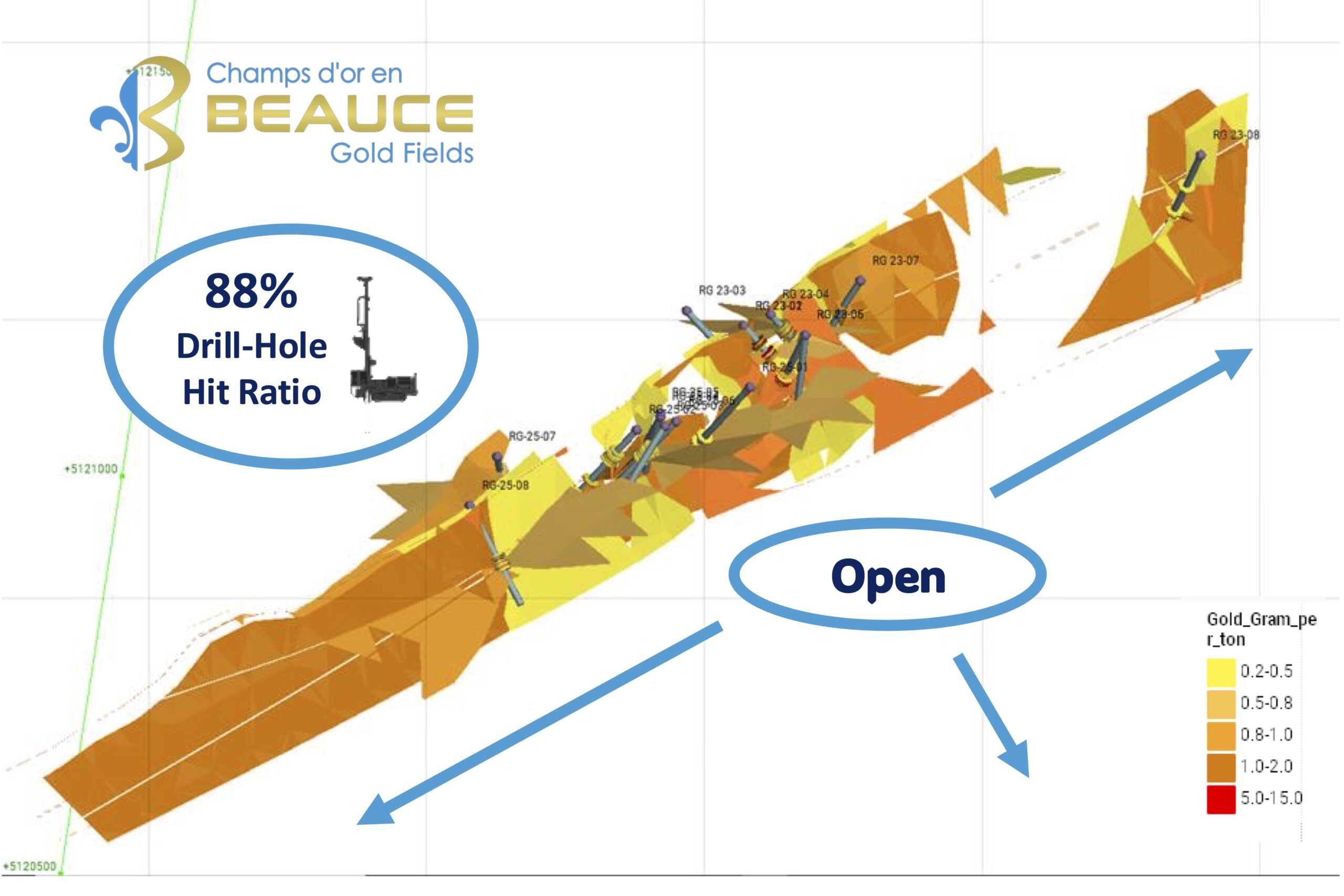
Image: 3-D geological model of the Grondin Zone’s antiform–saddle reef mineralized system
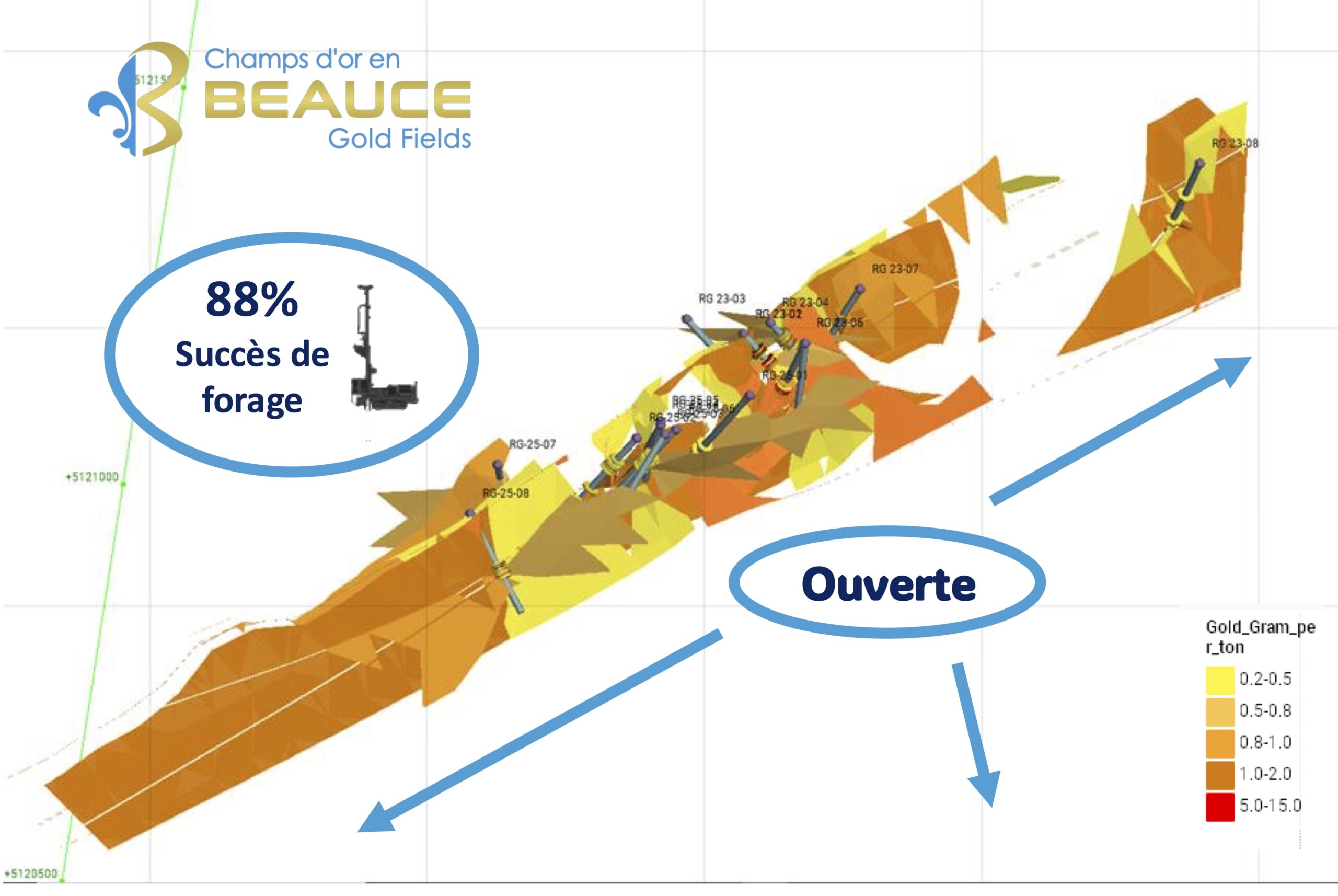
Image: 3-D geological model of the Grondin Zone’s antiform–saddle reef mineralized system
3-D Geological Model Highlights
The 3-D model incorporates digitized drill sections, gold assay intervals, lithological logs, and structural interpretations derived drill holes from the Grondin Zone, including 2023 holes GR-23-01 to GR-23-08 and 2025 holes GR-25-01 to GR-25-08, were digitized, georeferenced, and imported into Leapfrog™ to generate a high-resolution geological model of the antiform-hosted mineralized system. The model displays the discovery of gold-bearing hydrothermal breccias, quartz crack-and-seal vein pockets within a folded felsic lapilli tuff sequence.
- Gold-bearing intervals from 0.200 ppm to 11 ppm grouped into vertical planar sections by grade
- A folded, arcuate saddle-reef antiform geometry consistent with structurally repeated zones of gold enrichment
- A 600-metres mineralized strike length extending from GR-23-08toGR-25-08
- Mineralization traced to depths of ~40 metres, remaining open both along strike and at depth
High Drill Success Rate Validates Geological Model
The Leapfrog model confirms that the Company’s recent 2023 & 2025 combined Grondin drill programs were highly effective in targeting this structure:
- 14 of 16 holes returned gold ≥ 0.3 g/t Au
- 88% drill-hole hit ratio— significantly above the industry norm for grassroots exploration
- Confirms BGF is drilling within a robust, continuous mineralized corridor
BGF’s 88% success rate exceeds the performance of most discovery-stage junior explorers in Canada and underscores the strength of the Company’s structural model. In comparison, early-stage gold exploration typically yields only 20–40% mineralized drill holes, with programs exceeding 50% generally considered highly successful. Sources: Geological Survey of Canada (GSC) Paper 89-4 — Mineral Exploration Statistics and Probabilities in Canadian Greenstone Belts; Ontario Geological Survey (OGS) Paper 169 — Exploration Strategies in Archean Gold Camps; CIM Annual Conference Short Course: Exploration Decision-Making and Drilling Efficiency.
Table 1: 2023 and 2025 Drill Results
|
Hole No |
From (m) |
To (m) |
Interval (m) |
Au (g/t) |
|
RG-23-01 |
11 |
14 |
3 |
1.7 |
|
Including |
12.5 |
13.5 |
1 |
2.5 |
|
And |
17.3 |
19.5 |
2.2 |
5.4 |
|
Including |
18.5 |
19.5 |
1 |
8.85 |
|
Including |
19 |
19.5 |
0.5 |
11.4 |
|
And |
21.5 |
24 |
2.5 |
1.8 |
|
RG-23-04 |
8.5 |
14.5 |
6 |
1.08 |
|
Including |
12 |
14 |
2 |
1.9 |
|
Including |
13 |
13.5 |
0.5 |
3.6 |
|
RG-23-05 |
37.5 |
41 |
3.5 |
3 |
|
Including |
38 |
39 |
1 |
6.5 |
|
Including |
38 |
38.5 |
0.5 |
10.88 |
|
RG-23-06 |
42.5 |
43 |
0.5 |
2.8 |
|
And |
45.5 |
47.5 |
2 |
0.16 |
|
RG-23-07 |
34 |
36.5 |
2.5 |
0.51 |
|
Including |
35.5 |
36.5 |
1 |
0.81 |
|
Including |
36 |
36.5 |
0.5 |
1.27 |
|
And |
37.5 |
39 |
1.5 |
0.35 |
|
And |
50 |
51 |
1 |
0.92 |
|
Including |
50.5 |
51 |
0.5 |
1.6 |
|
RG-23-08 |
27 |
28 |
1 |
0.31 |
|
And |
48.2 |
50 |
1.8 |
1.1 |
|
Including |
48.5 |
49 |
0.5 |
2.2 |
|
GR-25-01 |
48 |
48,5 |
0,5 |
0,4 |
|
GR-25-01 |
49 |
50,5 |
1,5 |
0,25 |
|
And |
55 |
60 |
4 |
0,93 |
|
Including |
57,5 |
58,5 |
1 |
2 |
|
Including |
58,5 |
59 |
0,5 |
2,3 |
|
GR-25-02 |
20 |
24 |
4 |
2 |
|
Including |
21,5 |
22,5 |
1 |
2,8 |
|
Including |
22,5 |
23 |
0,5 |
5,2 |
|
And |
41 |
43 |
2 |
0,6 |
|
GR-25-03 |
55 |
55,5 |
0,5 |
0,106 |
|
GR-25-04 |
30,5 |
33,5 |
3 |
0,35 |
|
And |
42,5 |
46,5 |
4 |
0,51 |
|
Including |
42,5 |
43,5 |
1 |
1,1 |
|
GR-25-05 |
31,5 |
37 |
5,5 |
0,34 |
|
And |
32 |
32,5 |
0,5 |
0,791 |
|
And |
32,5 |
33 |
0,5 |
0,195 |
|
GR-26-06 |
22,5 |
22,4 |
1,9 |
0,22 |
|
And |
26,5 |
32,5 |
6 |
0,33 |
|
And |
47,5 |
49,5 |
2 |
1,15 |
|
Including |
48,5 |
49 |
0,5 |
2,4 |
|
GR-25-07 |
15,5 |
16,5 |
1 |
0,6 |
|
GR-27-08 |
30,5 |
40 |
9,5 |
0,8 |
|
Including |
32 |
33 |
1 |
2,3 |
Hole GR 23-02: Mineralized zone is slightly observed, gold below .300 ppm
Hole RG 23-03: No zone of interest was found in this drilling.
The procedures used for the recently reported drill results, which were previously published in press releases dated November 1, 2023, and September 11, 2025, followed strict QA/QC protocols. All drilling recovered HQ and NQ cores. Drill cores were split in half using a diamond saw. Half of the core was sampled and sealed in clean plastic bags before being shipped for assay. Standards and blanks were inserted on site. The remaining half of the core was replaced in core boxes and is stored at the Company’s core shack in Saint-Simon-les-Mines, Quebec. Samples were sent to MSALABS, Val-d’Or, Quebec. The entire samples were dried and crushed up to 1 kg to 70% -2mm and split into 500g samples. Each sample underwent Gamma ray analysis for gold by photon assay instrument.
The 3-D interpretation provides:
- Improved visualization of mineralized continuity across multiple drill fences
- Confirmation of saddle-reef geometry, a style of folding known globally to host high-grade gold zones
- Refined drill targeting for the upcoming winter drill campaign
- Identification of gaps, hinge positions, and fold repetition patterns requiring further testing
- Integration with the 8-km geophysical signature confirmed in the October 17, 2024 press release
Step-out drilling to test lateral continuation along the 600-m corridor - Deeper drilling than the vertical extent of confirmed mineralization
- Structural analysis to identify hinge-zone targets typically associated with high-grade saddle-reef deposits
- Integration with new geophysical, geochemical, and historical data sets
One key missing element is the precise dip and orientation of the gold-bearing structures. To resolve this, BGF plans to deploy a borehole televiewer to determine structural dip, planar features, and orientation parameters necessary to optimize deeper drilling.
The Company believes that the new 3-D interpretation significantly enhances its ability to define, target, and expand the gold-bearing structures of the Grondin Zone
Jean Bernard, BSc, Geo, a qualified independent person as defined by National Instrument 43-101, has reviewed and approved the technical content of this release.
Beauce Gold Fields is a gold exploration company focused on placer to hard rock exploration in the Beauce region of Southern Quebec.


Je tiens à vous féliciter pour la qualité de votre site web et pour le partage public que vous faites. Je suis un géologue – retraité. Mon commentaire consiste en questions en regard des teneurs en or de votre tableau 1 (Table 1: 2023 and 2025 Drill Results). Q1 – Est-ce que les résultats en or montrant de hautes teneurs sont le fruit “d’effet de pépites” résultant d’or grossier? Q2 – Si oui, les hautes teneurs en or ont-elles été “coupées”? Je présume que non, puisse que vous êtes en stage d’exploration…. Q3 – Avez-vous considéré d’analyser selon la même méthode d’analyse ou par “fire assay” des “duplicates” des “pulps” et des “core rejects pour fins de comparaison, ou êtes-vous satisfait de la méthode utilisé? Vous conservez , pour usage future , l’autre moitié de la carotte. Q4 – Avez-vous effectué une corrélation entre les résultats des “Gamma ray analysis for gold by photon assay instrument” versus “fire assays”? Merci de m’avoir permi de commenter.