




- Confirmed Gold-Bearing Mineralization Along Saddle Reef Traced for 4 km
- Unexpected Discovery of Gold-Bearing Mineralized Fault Line
Montreal, Quebec — Beauce Gold Fields (Champs D’Or en Beauce) (TSX Venture: “BGF”), referred to as “BGF” or the “Company,” referred to as “BGF” or the “Company,” is pleased to announce the results of its summer diamond drill program in Beauceville, Quebec. The shallow drill program, consisting of 13 holes totaling 970 metres, was carried out on the Giroux and Grondin gold showings.
Drilling intersected gold-bearing structures within the antiform Saddle Reef, with grades ranging from low to high. One drill hole testing an IP anomaly revealed a major fault zone hosting gold bearing mineralization. All mineralized zones remain open laterally and at depth, underscoring the strong exploration potential of the property.
Patrick Levasseur, President and CEO of Beauce Gold Fields, commented: “The drilling confirms a major underexplored Saddle Reef structure that remains open both laterally and at depth. The continuity of mineralization demonstrates strong potential for additional lode gold discoveries.”
Grondin Zone Highlights
- Highest grades were found near the axis of the Saddle Reef antiform. For example, hole GR-25-02 intersected 2.0 g/t Au over 4.0 m, including 5.2 g/t Au over 0.5 m.
- All zones remain open laterally and at depth, with mineralization extending several hundred metres at Grondin.
Drilling at the Grondin Zone followed up on the 2024 IP survey, which was largely conducted over the Grondin showing, already well delineated by 2023 drilling. The showing consists of a strong breccia subsequently invaded by extensive stockworks. These stockworks cut across the two main lithologies, forming a complex network of quartz veins and veinlets. Gold mineralization was encountered in most 2023 drill holes, with mineralized envelopes up to 10 m thick (e.g., RG-23-01). Gold is closely associated with sulfides occurring in quartz and/or host rock. Sulfides range from trace amounts to semi-massive clusters up to several centimetres in diameter. The principal gold-bearing sulfides include fine- to micro-grained pyrite, sphalerite, and arsenopyrite.
Notable Holes:
- GR-25-01: Drilled ~60 m southwest of Grondin. Intersected a gold zone from 48 m depth returned 0.9 g/t Au over 5 m (55–60 m).
- GR-25-02, GR-25-03, GR-25-06: Tested Grondin at various depths, confirming gold enrichment near the antiform axis. Best result: 5.2 g/t Au over 0.5 m at 22 m depth (GR-25-02). This aligns with 2023 drill holes returning up to 8.85 g/t Au over 1 m, including 11.4 g/t Au over 0.5 m.
- GR-25-07: Targeted anomaly PP-1 and high arsenic values from the 2024 soil survey. Intersected a weak gold zone near surface.
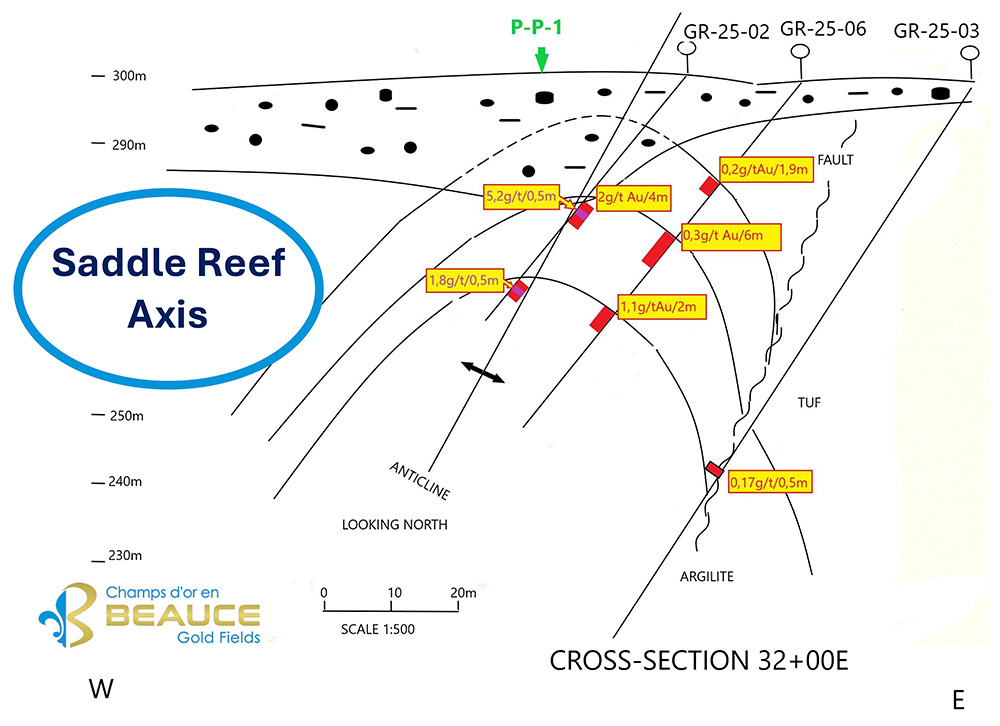
Image 1: Grondin Zone Holes RG-25-02 and 06
Hole GR-25-08 – Discovery of Gold-Mineralized Fault Line
Drill hole GR-25-08, designed to test anomaly PP-1, intersected strongly folded black argillite enriched in sulfides and cut by a major fault zone. This structure returned significant gold values, including 0.8 g/t Au over 9.5 m, with a higher-grade interval of 2.3 g/t Au over 1.0 m.
The Company interprets that certain faults cutting graphitic argillite horizons may host gold enrichment. To further evaluate this potential, cores from three 2023 holes and fourteen 2021 holes with similar lithologies will be re-examined and re-assayed.
This work will be complemented by a reinterpretation of geophysical surveys conducted by Fancamp Exploration (2018) and INRS (2018), the latter which identified a major fault line running parallel to the Saddle Reef and the paleoplacer channel. A 2021 report by Dr. Marc Richer Laflèche (INRS) recommended several follow-up holes along this fault, some of which remain untested. The Company intends to review drilled results and advance uncompleted targets, particularly north of the paleoplacer channel.
Future work will include detailed mapping, geochemistry, and targeted geophysical surveys (VLF and/or IP) to refine drill targets. Fault zones may be effectively traced using low-cost VLF electromagnetic surveys, which will guide reinterpretation of datasets and future drill planning.
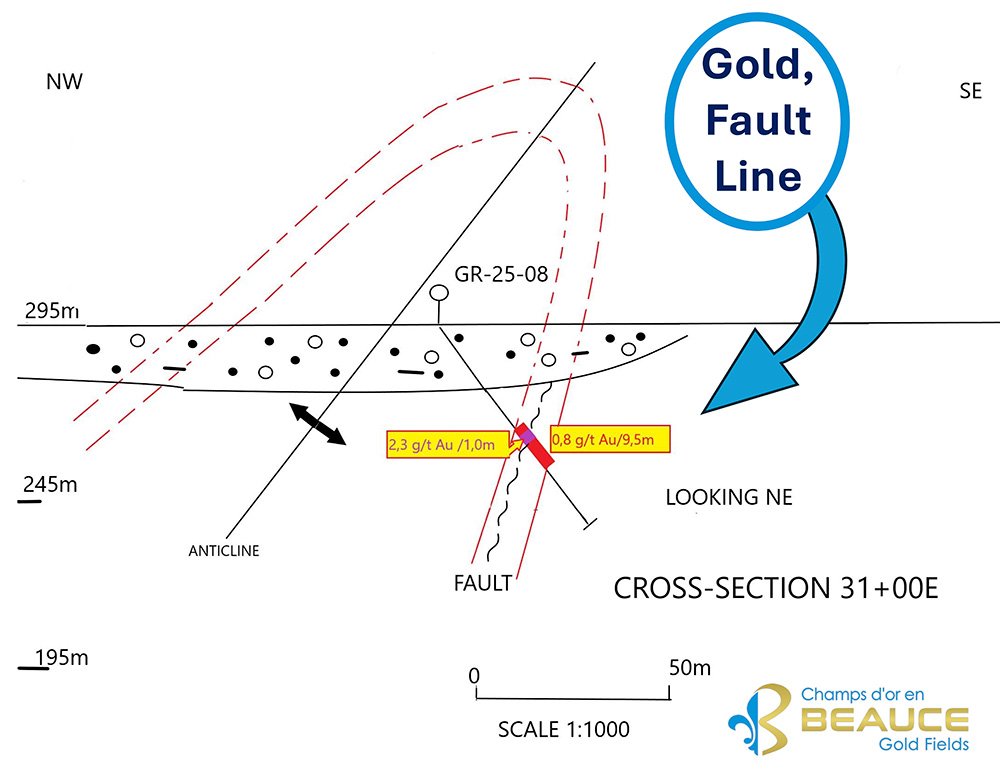
Image 2: Cross Section Hole GR-25-08 and Fault Line
Giroux Zone Highlights
- NE limb of an antiform returned a broad intersection of 16.5 m @ 0.25 g/t Au, including 0.8 g/t Au over 0.5 m (BE-25-03).
- Structural interpretation suggests a mega-antiform fold controlling gold mineralization; the SE limb remains untested.
- Confirms gold mineralization along the Saddle Reef traced for 4 km from Grondin Zone.
- Evidence indicates eroded precious-metal horizons contributed to historical placer gold in Giroux Brook and the Gilbert River.
A few hundred metres north of Giroux, hole BE-25-01 tested IP and soil anomaly PP-5 (Press Release, Dec. 10, 2024). The hole, drilled to 81 m, intersected mainly grey shale, but the source of the anomaly remains unexplained.
Other holes (BE-25-02 to BE-25-05) intersected mineralized lapilli tuffs with quartz veins hosting pyrite and arsenopyrite. Results included:
- 0.15 g/t Au over 6 m (BE-25-02).
- 16.5 m @ 0.25 g/t Au including 0.8 g/t Au over 0.5 m (BE-25-03).
- 0.19 g/t Au over 1.7 m (BE-25-04).
Interpretation suggests a mega-antiform fold, with three gold-bearing lapilli tuff horizons on the NW limb. The SE limb near Giroux Brook remains untested due to terrain access issues.
It is also interpreted that erosion of precious-metal-bearing layers released gold into the Giroux Brook drainage, feeding the Gilbert River. This brook was central to 19th-century placer gold mining.
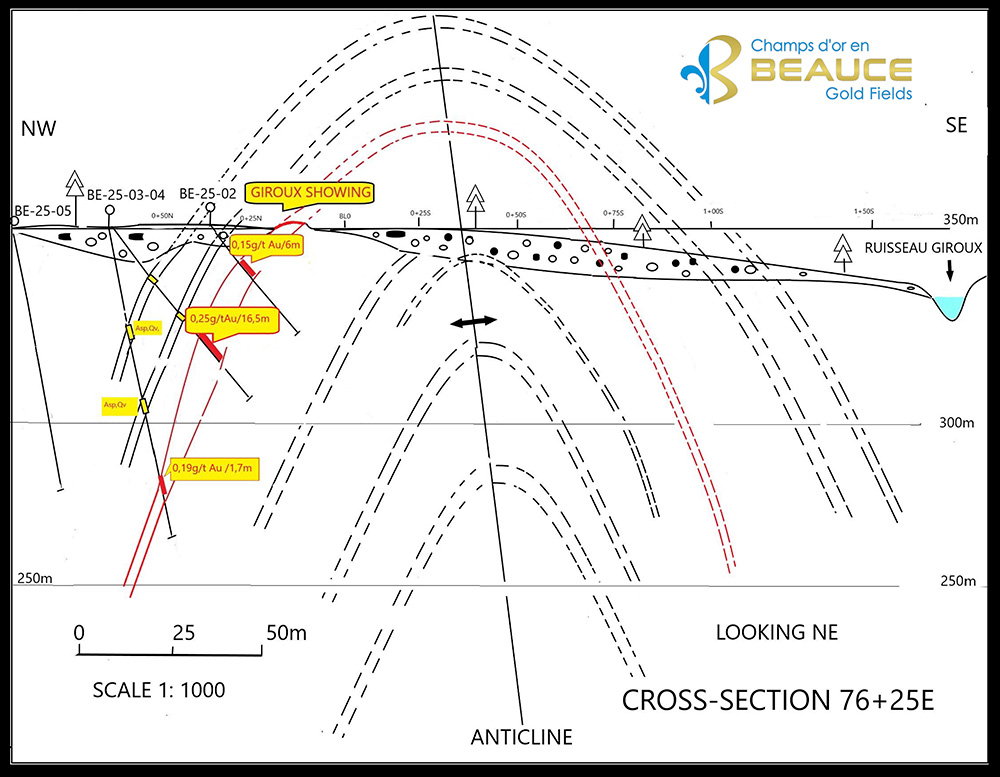
Image 3: Cross Section Giroux Zone
Table 1: 2025 Drill Results
|
Area |
Hole No |
From (m) |
To(m) |
Interval(m) |
Au (g/t) |
Note |
|
Giroux |
BE-25-02 |
12 |
18 |
6 |
0,15 |
|
|
Including |
14 |
15 |
1 |
0,3 |
||
|
And |
22 |
22,5 |
0,5 |
0,17 |
||
|
Giroux |
BE-25-03 |
32,5 |
49 |
16,5 |
0,25 |
|
|
Including |
48,5 |
49 |
0,5 |
0,8 |
||
|
Giroux |
BE-25-04 |
80,3 |
82 |
1,7 |
0,19 |
|
|
Grondin |
GR-25-01 |
48 |
48,5 |
0,5 |
0,4 |
|
|
GR-25-01 |
49 |
50,5 |
1,5 |
0,25 |
||
|
And |
55 |
60 |
4 |
0,93 |
||
|
Including |
57,5 |
58,5 |
1 |
2 |
||
|
Including |
58,5 |
59 |
0,5 |
2,3 |
||
|
Grondin |
GR-25-02 |
20 |
24 |
4 |
2 |
|
|
Including |
21,5 |
22,5 |
1 |
2,8 |
||
|
Including |
22,5 |
23 |
0,5 |
5,2 |
||
|
And |
41 |
43 |
2 |
0,6 |
||
|
Grondin |
GR-25-03 |
55 |
55,5 |
0,5 |
0,106 |
|
|
Grondin |
GR-25-04 |
30,5 |
33,5 |
3 |
0,35 |
|
|
And |
42,5 |
46,5 |
4 |
0,51 |
||
|
Including |
42,5 |
43,5 |
1 |
1,1 |
||
|
GR-25-05 |
31,5 |
37 |
5,5 |
0,34 |
||
|
And |
32 |
32,5 |
0,5 |
0,791 |
||
|
And |
32,5 |
33 |
0,5 |
0,195 |
||
|
GR-26-06 |
22,5 |
22,4 |
1,9 |
0,22 |
||
|
And |
26,5 |
32,5 |
6 |
0,33 |
||
|
And |
47,5 |
49,5 |
2 |
1,15 |
||
|
Including |
48,5 |
49 |
0,5 |
2,4 |
||
|
GR-25-07 |
15,5 |
16,5 |
1 |
0,6 |
||
|
GR-27-08 |
30,5 |
40 |
9,5 |
0,8 |
Fault Line |
|
|
Including |
32 |
33 |
1 |
2,3 |
QA/QC
The drill program followed strict QA/QC protocols. All drilling recovered HQ cores. Drill cores were split in half using a diamond saw. Half of the core was sampled and sealed in clean plastic bags before being shipped for assay. Standards and blanks were inserted on site. The remaining half of the core was replaced in core boxes and is stored at the Company’s core shack in Saint-Simon-les-Mines, Quebec. Samples were sent to MSALABS, Val-d’Or, Quebec. The entire samples were dried and crushed up to 1 kg to 70% -2mm and split into 500g samples. Each sample underwent Gamma ray analysis for gold by photon assay instrument.
Certified Reference Materials from MSALABS, Val-d’Or, Quebec (Certificates YVO2510903, 2510924, 2510948, 2510993, and 2511054). MSALABS is ISO-17025 accredited for photon assay.
Jean Bernard, BSc, Geo, a qualified independent person as defined by National Instrument 43-101, has reviewed and approved the technical content of this release.
Conclusion
The 2025 drilling program has confirmed structurally controlled gold mineralization at both Giroux and Grondin. Combined with 2023–2024 exploration work and updated placer Exploration Targets, these results demonstrate the strong potential of the Beauce Gold property to host both significant placer and bedrock lode gold deposits.
The Company plans to apply for an expansion of its ATI Authorization from Quebec’s Ministry of Natural Resources (MRNF) to allow additional “impact exploration work” and further drilling.
Pending results include silver and other trace elements. Silver, an important secondary element, was prominent in 2023 drill results and gold grain analysis, and was also significantly mined during historical placer operations (Press Release, June 13, 2024). Key pathfinder elements include silver (Ag), arsenic (As), barium (Ba), and antimony (Sb). The frequent association of barium with anomalous gold zones underscores its value as a geochemical indicator.
Beauce Gold Fields is a gold exploration company focused on placer to hard rock exploration in the Beauce region of Southern Quebec.