




Montreal, Quebec — Beauce Gold Fields (Champs D’Or en Beauce) (TSX Venture: “BGF”), referred to as “BGF” or the “Company,” is pleased to report results from a recent field visit and data compilation on its CH-98 Phosphate Property in the Lac-Saint-Jean region of Québec.
The property comprises 34 map-designated exploration claims (DEE) and is situated near Arianne Phosphate’s flagship Lac à Paul project area. The work program focused on verifying the location of the historical CH-98-61 phosphate showing, collecting samples and field observations, and outlining the next phase of exploration.
Technical Highlights
- Historic high-grade rock sample at CH-98-61: A Québec MERN (1998) analysis reported 8.59% P₂O₅ from apatite-bearing anorthosite at the outcrop showing. A nearby stream-sediment sample returned 1.5% elemental phosphorus (15,000 ppm P), supporting local phosphate enrichment.
- Apatite-rich anorthosite at surface: Outcrops along the Lac Froid forest road expose granoblastic anorthosite with ~10–25% coarse greenish-yellow apatite, locally cut by a fine-grained dark unit. A float block of similar apatite-rich anorthosite was found approximately 150 m away, suggesting additional targets beyond the immediate exposure.
- Conventional Fe-Ti-P host rocks to the east: Mapping in the eastern sector identified gabbro-norite with 5–10% apatite, consistent with more typical Fe-Ti-P horizons recognized in the Lac-Saint-Jean anorthositic suite.
- Massive Fe-Ti oxide potential to the north: A compiled historical rock analysis north of the property reports 64.42% Fe₂O₃(t), 21.4% TiO₂, and 0.25% V, indicative of massive iron-titanium oxide mineralization in the broader area.
Patrick Levasseur, President and CEO of Beauce Gold Fields, commented: “With apatite-rich anorthosite exposed at surface and conventional Fe-Ti-P anomalies in the district, CH-98 fits squarely within our Québec Phosphate strategy. Our goal is to advance near-surface targets in an established mining camp and position Beauce Gold Fields to contribute to secure North American phosphate supply chains—creating value for shareholders while advancing a mineral that Canada and Québec now recognize as critical for fertilizers and LFP battery cathodes.”
Geological Context and Interpretation
CH-98 is hosted within the Lac-Saint-Jean anorthositic suite, where apatite-bearing anorthosite and mafic cumulates (including gabbro-norite) are common phosphate hosts. At CH-98, the concentration of apatite within deformed (granoblastic) anorthosite, proximal to a NE–SW-oriented fault corridor, supports a structural model for phosphate that complements the region’s conventional Fe-Ti-P targets.
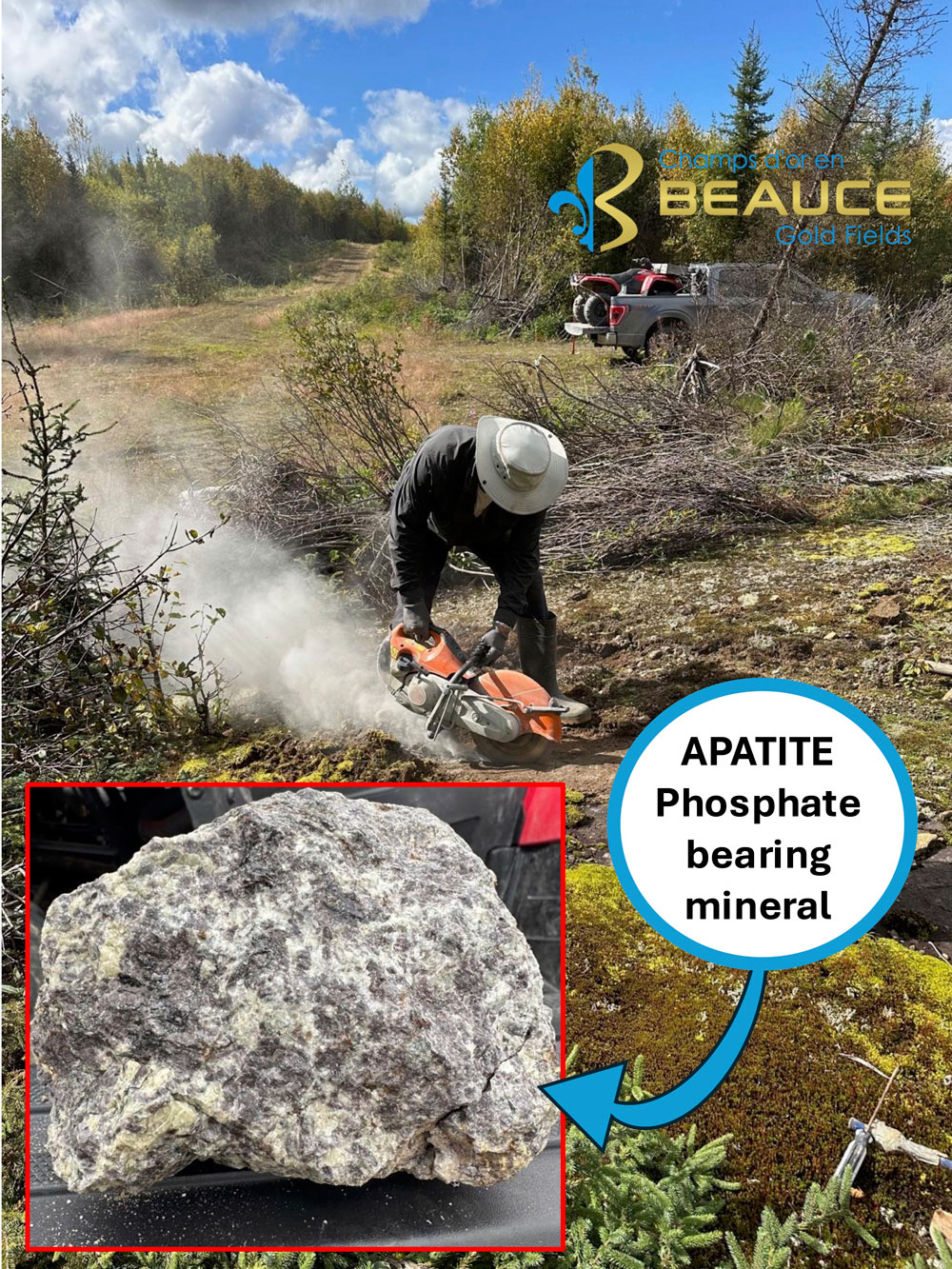
Image: CH-98 property, inset sample 2025-0115
Sampling and Next Steps
Grab samples, including an approximately 20 kg bulk sample of apatite-rich granoblastic anorthosite, were collected. The sample will be sent to COREM (Québec City) to perform apatite separation tests to determine recovery rates, and analyze for concentrations of P₂O₅%.
The Company plans to advance a multi-pronged exploration program that will:
- Conduct mechanical stripping and washing of outcrops to define the lateral extent of apatite-rich zones;
- Acquire high-resolution ground or UAV magnetics to trace Fe-oxide-rich units and delineate structures (including faults) that may control phosphate enrichment;
- Undertake detailed prospecting, mapping, and channel sampling directed by geophysics; and
- Perform follow-up prospecting in the northern sector for massive oxide targets.
The technical information contained in this news release has been reviewed and approved by Christian Tremblay, B.Sc., P.Geo., a Qualified Person as defined by National Instrument 43-101.
Advancing Québec Phosphate
CH-98 strengthens Beauce Gold Fields’ broader Québec Phosphate initiative, adding a target with both structural apatite concentration and conventional Fe-Ti-P potential in a district anchored by established phosphate-titanium systems. Phosphate is essential for fertilizers and is a key component of LFP (lithium iron phosphate) battery cathodes. The Company’s strategy is to advance near-surface targets with potential to contribute to North America’s critical minerals supply chain. Phosphate was recently added on Canada’s and Québec’s critical minerals lists

Beauce Gold Fields is a gold exploration company focused on placer to hard rock exploration in the Beauce region of Southern Quebec.